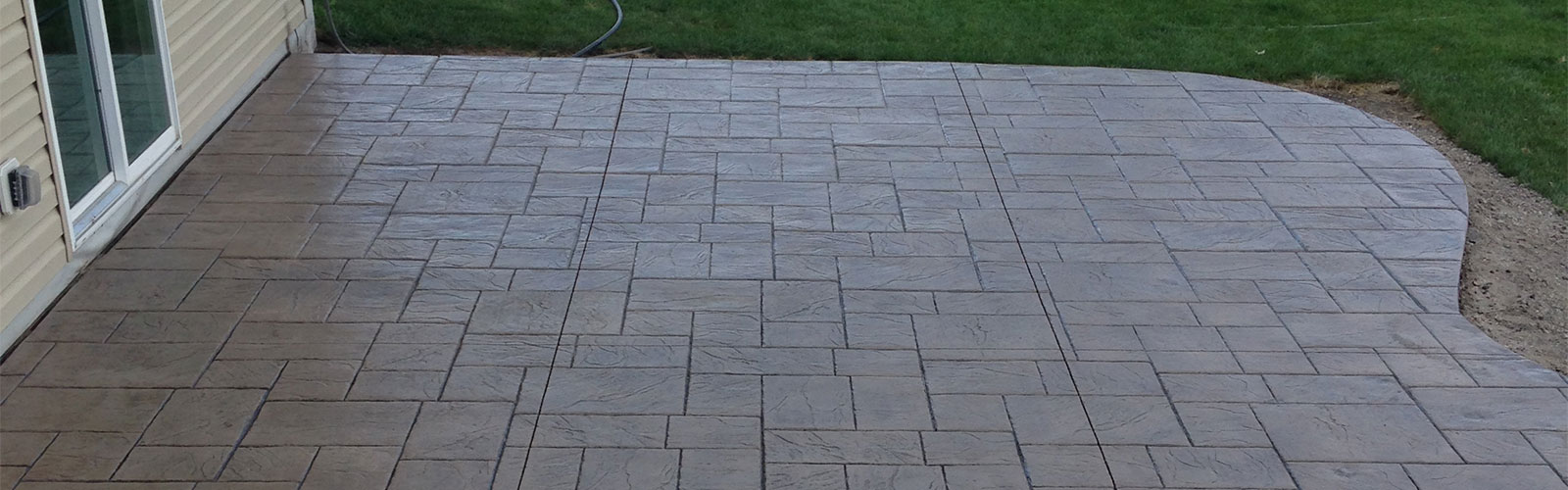
Before we get into the comparison, it’s worth mentioning what we mean by “pavers.” Pavers are blocks of concrete, natural stone, or clay. They are flat, interlocking units that fit together to form a surface. They come in a wide range of shapes and sizes, from small squares to large rectangular slabs. This page focuses on concrete pavers, which are by far the most common and what most people are picturing when they say “paver patio.”
At a glance, stamped concrete and concrete pavers can seem like similar choices for your patio. In practice, they perform very differently once installed.
Using Stamped Concrete for Patios
When a concrete surface has been imprinted with a pattern while it’s still wet, it’s stamped concrete.
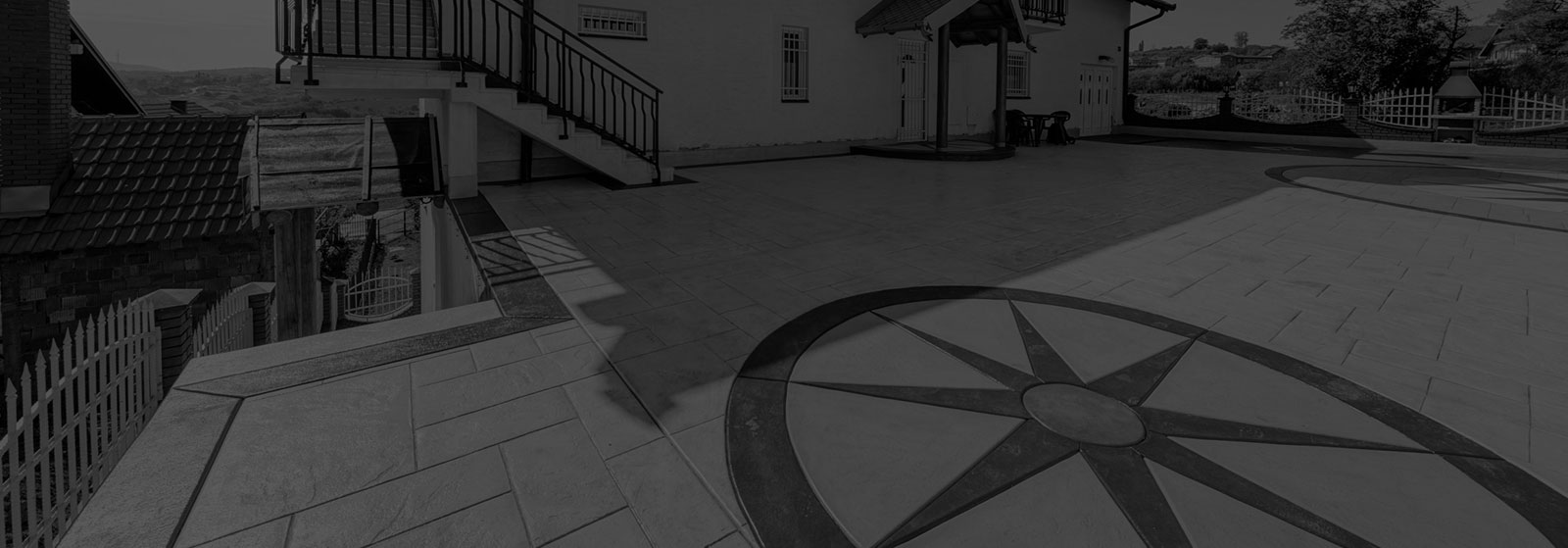
It can look like brick, stone, wood, or just about any other textured pattern you can imagine. Want a patio that looks like weathered Yorkstone, or oak planks without the splinters? With stamped concrete, we imprint the pattern into the surface while the concrete is still wet, and add pigments directly into the mix so the color goes throughout the material, not just on top. You’re not choosing between appearance and performance. You’re getting both.
Stamped concrete has far fewer seams than a paver patio. In a 15-by-20-foot patio, a stamped concrete surface would typically have three or four seams, which are there to help prevent cracking. That same patio built with concrete pavers requires around 800 individual units (the exact number depends on the paver size), each surrounded by joints. That’s a big difference when it comes to weeds and accumulated dirt.
Stamped concrete is usually less expensive up front than pavers, and we can pour and stamp a patio in a fraction of the time it takes to lay pavers individually.
For many homeowners, that combination makes stamped concrete the more practical choice.
Using Pavers for Patios
Concrete pavers come in a wide variety of shapes, sizes, and colors. You can mix and match different units to create patterns like herringbone, basketweave, or running bond, and you can combine different colors and sizes within the same patio for a custom look. That variety is one of their biggest selling points.
Pavers are very strong. Their interlocking design also lets them move slightly with the ground instead of cracking, which is a practical advantage in a frosty climate like ours.
If a paver cracks or shifts, you can pull it out and replace it without disturbing the rest of the patio.
One thing to be aware of with concrete pavers is color fading. The pigment in a concrete paver sits in a thin layer at the surface. As foot traffic, weather, and cleaning wear that layer down, the aggregate underneath starts to show through, and it’s often a different color. This can start to become noticeable within a few years, especially in high-traffic areas. Once that surface layer wears down, the original color is difficult to fully restore.
Paver patios come with all the joint-related issues you’d expect from a surface made of hundreds of individual pieces. Weeds will find their way in, uneven pavers become trip hazards, and the seams can make it hard to shovel snow. These issues tend to build gradually over time.
Comparison: Stamped Concrete vs. Pavers
Both materials have strengths and both come with tradeoffs. Here’s how they stack up.
Design flexibility is closer here than in most patio comparisons. Pavers give you a lot of options for shapes, sizes, and colors that you can mix and match freely. Stamped concrete is flexible in a different way. Because it’s a continuous surface, it can create the appearance of a large, unbroken expanse of natural stone or wood, without many joints interrupting the pattern. Pavers will always have that more pieced-together look. Whether that’s a pro or a con depends on your taste.
Installation time favors stamped concrete. We can pour and stamp a patio in a day or two. A paver patio takes longer because each unit is placed individually.
Longevity slightly favors pavers. Concrete pavers typically last 25 to 30 years. Stamped concrete lasts 20 to 25 years in Minnesota with proper maintenance.
Color retention favors stamped concrete. The color in a stamped concrete patio is integrated into the slab, while concrete paver color is concentrated at the surface and wears away with time. It’s common for concrete pavers to look somewhat faded after a few years. Stamped concrete holds its color longer. Over time, this difference becomes more noticeable across the entire patio.
Up-front cost is close between these two. Stamped concrete still tends to come in a bit lower, but on a given project, they can be very comparable.
Winter performance is worth discussing for any patio in Minnesota, where we see 50 or more freeze-thaw cycles a year. Stamped concrete manages this through air-entrained mixes and control joints that guide any cracking. Pavers manage it through their interlocking design, which lets individual units move with the ground. The downside of that flexibility is that you may need to relevel areas that have shifted after winter.
Maintenance looks different for each. Stamped concrete needs resealing roughly three times a decade. It’s straightforward and quick, but it needs to happen on schedule. Pavers don’t strictly require sealing, but skipping it means the color fades faster. Either way, paver joints need the periodic attention of topping up polymeric sand, pulling weeds, and resetting any units that have come loose.
Day-to-day use is simpler with stamped concrete. Fewer joints means less opportunity for dirt, weeds, and insects to accumulate, and the surface is easier to sweep and shovel.
Repairs favor pavers. Swapping out a single paver is simple. Repairing stamped concrete means trying to match the original color and pattern, which is more difficult.
Pros and Cons of Stamped Concrete & Pavers
Stamped Concrete Pros
- Great range of patterns, textures, and colors
- Better color retention than concrete pavers
- Fewer seams, easier to sweep and shovel
- Lower up-front cost (though close)
- Faster installation
Stamped Concrete Cons
- Resealing every few years
- Repairs can be difficult to color-match
- Slightly shorter lifespan than pavers
Paver Pros
- Wide variety of shapes and sizes to mix and match
- Strong and resistant to cracking
- Easy to repair individual units
- Interlocking design handles ground movement well
Paver Cons
- Color can wear off or fade within a few years
- Longer installation time
- Joints need more ongoing maintenance
- Can become uneven after freeze-thaw cycles
Stamped concrete might be your best bet if:
You want a large surface with the fewest number of seams. You’re drawn to looks that pavers can’t achieve, like natural stone textures or wood plank patterns. Color retention matters a lot to you. Or you’d prefer a faster installation with simpler day-to-day upkeep.
Pavers might be the better choice if:
You like the look of individual units and want to combine different shapes, sizes, and colors. Easy repairability is a priority. Or you want the flexibility to make changes down the road; because pavers aren’t locked in place, they’re easier to remove or modify later.
The Bottom Line
Stamped concrete and pavers are both popular for good reason, and the right choice depends on what matters most to you.
For a lot of homeowners, stamped concrete is the more practical choice due to easier upkeep and faster installation, while pavers stand out for repairability and flexibility.
If you’re leaning toward stamped concrete, we’d love to help you find the right pattern, color, and design for your home. If you’re still on the fence, we’re happy to walk through the options with you. We serve the entire Twin Cities area. Give Creative Concrete a call at 612-414-7932 or request a free quote to get started.
What Customers Say
“Bryan and his crew were outstanding!! They put in 2 large patios for us, as well as a new front walk. We were super impressed with each gentleman that came out to our home — they were kind & polite, knowledgeable, hard-working, and very thorough in their clean up. Their work is beautiful! We highly recommend Creative Concrete, and would do business with them again in a heartbeat!!” – Katie Vick (see review on Google Maps)
“Creative Concrete just finished our patio and it looks better than I could have ever imagined! They helped with picking out a great color to compliment our house color and the texture is beautiful. The crew worked quickly and did a great job keeping the area neat and clean. Highly recommend for a professional patio!” – Stacy Woodbury (see review on Google Maps)
“Brian and his team helped us put in a poolside patio and were a pleasure to work with, beginning to end. I appreciated the two trips out to the site Brian made based on some back and forth dialog and to make sure everything would go smoothly. Both advance and week of communication left me with a good feeling that I was working with professionals. On-site crew was also friendly and professional. Enjoying our patio, thank you Creative Concrete.” – Ryan Oliveira (see review on Google Maps)
“Bryan and his crew did an exceptional job at removing a large concrete pool deck and installing a colored stamped patio. They are great to work with and I could not be more pleased with the quality workmanship. I highly recommend them!!” – Lynn Dittrich (see review on Google Maps)